Common questions
Questions about tactile restroom maps.
The questions we hear most from facilities teams, accessibility coordinators, and blind visitors. If yours is not here, write to us and we will answer it.
What is a tactile restroom map?
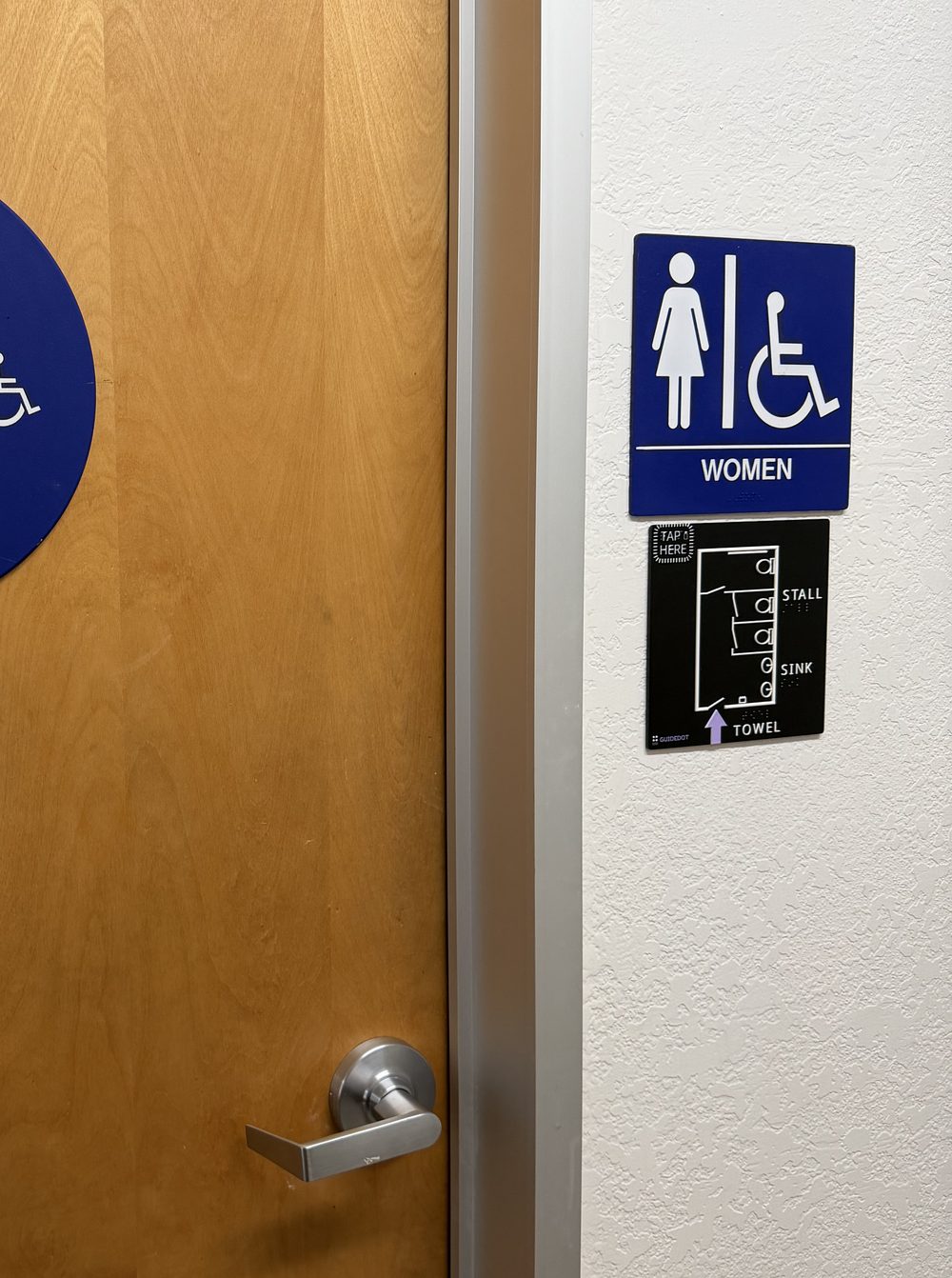
A tactile restroom map is a raised floor plan of a restroom, mounted on the wall next to the entrance. You read it with your fingertips before you go in. The walls, stalls, sinks, and amenities are raised icons, each labeled in braille and high contrast print, and an arrow marks where you are. In a few seconds you know the shape of the restroom and where everything is, so you can walk straight to what you need instead of searching by hand.
Every GuideDot map is custom to its room, because restrooms are almost never identical, even in the same building.
Who is it for?
- Blind visitors feel the layout map, then use the restroom without touching surfaces they did not mean to touch.
- Low vision visitors see the bold, high contrast layout and the large print labels up close.
- Wheelchair users see which stall is the accessible one and where it is before opening any doors.
- Parents find the changing table.
- Seniors and people with limited mobility know which stall has grab bars.
- First-time visitors in an airport, campus, hospital, or venue get a quick preview of an unfamiliar room.
- Facilities and accessibility teams get a visible, touchable sign that the facility takes access seriously.
What kinds of buildings use it?
Any building with a public or shared restroom. GuideDot maps are made for transit stations and airports, university and school buildings, libraries and museums, hospitals and clinics, offices and coworking spaces, hotels, conference and event venues, restaurants and cafés, and government buildings. Single-user rooms, multi-stall rooms, all gender rooms, and family or companion care rooms are all covered.
Where on the wall does it go, and how does a blind person find it?
The map goes directly below the ADA sign next to the restroom entrance. Blind visitors already look for that sign to check whether a restroom is men’s, women’s or all gender, so the map is right under their hand. It mounts with adhesive, with no screws or drilling, and we work with your facilities team to put it up.
To help people find it, tell your front desk and staff about the map, and add a line to your website’s accessibility page. Blind visitors often check that page before they arrive.
The Tap to Hear pad in the map’s top corner, marked TAP PHONE TO HEAR in print and braille, opens an audio description of the restroom when a visitor touches their phone to it. Visitors can also tell us what they think of the map there.
How long does it take?
We send you the designs within four weeks of the survey. Once you approve them, we deliver the maps within four weeks.
What does it cost?
Every map is $200, whether the restroom is simple or complex. That covers the survey, the design and the printing, and we work with your facilities team on the installation. To get started, email ania@guidedot.io.
Ask us anything else.
Write to us and we’ll get back to you. We can also send a sample map if you’d like to feel one first.